Aviva vs. the Dybbuk, by Mari Lowe, at BookPage
The Beatryce Prophecy, by Kate DiCamillo, at Sonderbooks
The Lock-Eater, by Zack Loran Clark, at Cracking the Cover
Scott Southall (The Order of Time series) at Gina Rae Mitchell
Back in 2017, I successfully guessed the The Girl Who Drank the Moon had a good shot at the Newbery. Last year's winner was also fantasy (or at least very fantasy adjacent)--When You Trap a Tiger, by Tae Keller. Will another fantasy/sci fi book win this year? Here are some I think might have a chance.
The Raconteur's Commonplace Book, by Kate Milford (my review). This is my top pick. I think it is the strongest writing of any mg I've read this year. Not only did I personally love it and find it entertaining, I think if the committee wants "literature" this might be it.
The Last Cuentista, by Donna Barba Higuera (my review) A strong contender primarily based on the incredibly powerful story.
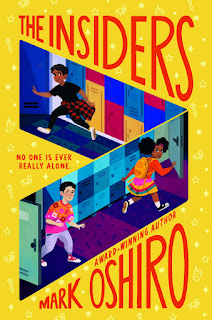
Root Magic, by Eden Royce (my review) A powerful, moving, well-written story that is also important.I still have a backlog of review to write for many excellent books read for this year's Cybils Awards; there were so many good ones that I read last fall but the reading was more important back than then the reviewing....and so this evening I offer The Insiders, by Mark Oshiro (September 2021, HarperCollins), is an affirmative portal fantasy that was pretty much a read-in-a-single-sitting for me.
Hector's family has moved to a new town from San Francisco, where he was happy and confident as a gay Mexican American theatre kid, with a tight group of friends and a taste for style and thrifting. Things go badly for him at his new school, when he's targeted by a truly cruel boy, Mike, and his crew of bullying lackies. The school staff are no help, refusing to believe Mike is a problem. Miserable and desperate to escape his tormentor, Hector finds a door in the school hallway that opens into a room that shouldn't be there. It is retreat designed just for him, and though no time passes when he's inside, when the door opens again, the hallway is empty.
Soon he finds that two other kids, from schools in different states, have also found the room. One is girl whose principal is about to tell her mother she is gay, the other a lonely non-binary kid. They too need an escape place, and the three become supportive friends. But the room, though magical, is still a room, and Hector must come up with his own plan for exposing Mike and getting justice.
I have to say that the bullying part is hard reading. It hurts to see Hector being treated so badly, and becoming sad and diminished, and this might well be painful reading for kids, especially gay kids, in similar circumstances (I am glad that although Mike's reasons for being such a homophobic monster are hinted at, we aren't given a redemption arc for him--that would have been too much to swallow). The magical room part, and the friendships he builds both there, and, with a bit more effort, with other "misfit" kids at his own school, though, makes for warm and friendly reading. And it's lovely to see Hector's supportive family (and maybe it's shallow of me, but I also appreciated the delicious Mexican food that was eaten along the way....)
It's great that a very gay magical-portal fantasy is out there in the world, and I hope that the kids (straight and queer) who need it find it, even if they can't get into the wonderful room.
disclaimer--review copy received from the publisher for Cybils Awards purposes.
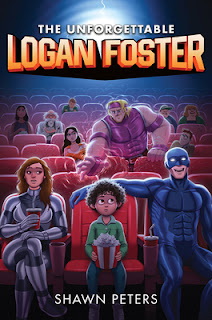
Logan Foster is not a superhero. He's a kid who's bounced in and out of foster homes, and now that he's twelve, his hopes of getting adopted are practically nil. It's hard for him to imagine prospective parents who want a kid with an eidetic memory that pours information from his mouth in an unexpected, and often unwelcome, way, a kid whose social skills are non-existent. But then Gil and Margie arrive, and maybe he has found a real home...
Except that Gil and Margie are seriously weird. Logan's memory records every perplexing thing he notices, but the actual reason was not something he could have guessed--they are superheroes, whose adventures have been chronicled in the comic books Logan loves!
Superheroes have been going missing, an earthquake-causing villain is terrorizing the west coast, and now Logan and his memory are pawns in a struggle to control his foster parents and the other superheroes who had dedicated their life to the common good. And though Logan might not be traditionally super-powered, his gifts are key to saving the day! (Helped by an new, actual friend--a neighborhood girl who is also more than she seems to be; she is a great character, btw).
It's a fun (also funny) and fast-paced, with mortal peril and considerable action once things really get going. The reader is essentially told by Logan that he is unlikeable, but this is not the impression the reader, who sees from his point of view, gets (the reader, of course, doesn't actually hear a constant flood of whatever information is bubbling up in Logan's mind, which one can see would potentially be annoying). Instead, Logan, to me at least, was a neuro-divergent kid who desperately needed love, appreciation, and validation, and it was great to see him getting those from both his new foster parents and his new friend! I hope we get another book--this one ends with some questions still unresolved.
In short, an excellent addition to the corpus of MG superhero stories!
disclaimer--review copy received from the publisher
I still have lots of great books read for the first round of the Elementary/Middle Grade speculative fiction Cybils to review...and so I'm squeezing on in this morning to include in my regular EMG spec fic Sunday roundup.
Pencilvania, by Stephanie Watson (August 2021, Sourcebooks), illustrated by Sophia Moore, is a moving portal fantasy that will especially appeal to creative young readers.Zara has been drawing all her life. Encouraged by her mother, she fills sketchbook after sketchbook, and the walls of her house are covered with her drawings. But then her mother gets cancer, and dies. Zora and her little sister Frankie have to live with their grandmother, who is almost a stranger (in a basement apartment, in a different town). The spark of Zora's passion for art, so closely tied to her mother, fizzles out. Instead, in her anger and grief, she starts to furiously scribble over all her old drawings, destroying her old life.
But this destruction opens the way into the world of Pencilvania, and Zora and Frankie find themselves in a place where everything that Zora ever drew, including pictures of their mother, is alive. Pencilvania is in danger, though--one angrily scribbled out horse, Viscardi, is determined to complete the ruination of Zora's art, and all the other scribbled out creatures she's drawn have fallen under his domination.
If Zora can find the mother she drew as a superhero, maybe she can save Pencilvania, and herself and Frankie, and make everything all right again.
And so their journey begins through a wildly magical world of art come to life, to the final realization that their mother can't, in fact, save them, and it's up to Zora.
Zora's grief is vividly real, and desperately sad. But the story itself is not just about this sadness--Pencilvania is full of humor; many of its denizens are childhood scribbles (the blobby eeks for instance, and there's also many charming hamsters from the hamsters in pajamas series she drew. A seven legged horse becomes her greatest helper, and he's a lovely character in his own right. Sophia Moore's illustrations add to the charm. The danger is very real, though, and Viscardi is a frightening villain....
It's encouraging to watch Zora grow in maturity during her adventures, and it's great that at the end she gets her creative spark back, and is willing to give her grandmother a chance.
In short, an engrossing read that offers an accessible look at a difficult topic; best for younger middle grade readers.
(review copy received for Cybils Awards)
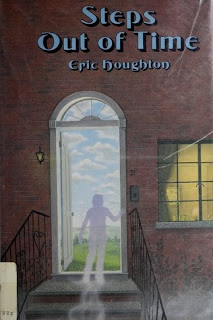
Jonathan and his father have just moved into a house of their own in a small English town (Jonathan's mother is dead). The house needs lots of work to make it into a comfortable home, but both of them are optimistic about it. Jonathan, shy and kind of social awkward, is a lot less optimistic about being the new kid as school, and indeed, quickly finds himself the butt of unkind jokes.
Walking home from school, he takes comfort from the thick mist that gathers along the river at twilight... but then, walking through it back to his home, he opens the door to find a strange house, with strangers living in it. He tries to believe it's just a confusion from the mist, but it happens again, and he's forced to accept that sometimes he walks into a different reality. The oddest thing is that in that reality he is a boy named Peter, with Peter's words flowing naturally out of this mouth, and Peter's body doing things Jonathan couldn't do--rowing and climbing and drawing and painting brilliantly. Lots of things are different in this reality--landmarks in the town have changed, and there is strange technology. It is, in fact, the future.
Jonathan's time spent living as Peter, with Peter's family, especially his sister Helen, changes Jonathan; even back in his own body he retains some of Peter's muscle memory, and his art wins him the admiration of his peers and becomes a bridge leading to group acceptance. And whatever magic drew him into Peter's time comes to an end. There are lots of bits I liked about Jonathan figuring out he can draw and paint--full of good detail about shading and perspective and light, etc.
If this sounds like a somewhat slight plot, that's because it is. But it is very atmospheric and fascinating. I ended the book thinking the author was not very good at future tech, and indeed those bits of the book were often awkward reading, but then I did the math. I was about the same age as Jonathan in 1979, and it is now about the same age as the fictional future time. I wouldn't have had any trouble with the portrayal of the future if I'd read the book when it first came out, so it's not a fair criticism!
One place where I am still very sure the author faltered is with regards to Peter's mother in the future. Jonathan has lost his own mother, and is periodically embodied as another boy with a loving mother--this should have elicited strong and poignant emotion, but didn't. A lost opportunity, which weakened the book.
But in any event, I think I would have loved it as a child* --and even as an adult, I find myself replaying it in my mind's eye, seeing the images from the story vividly, and filling in emotional weight that isn't in the original. I was impressed enough by the book to see what else Eric Houghton wrote, and am disappointed that most of his books seem to be for younger children than me (or about Sparticus). I have added Gates of Glass to my tbr list, though.
*every summer my sisters and I went back to the United States to stay with our grandparents, and I tried to read all the books in the children's section of the Arlington VA Central Library. Some summers I started at A. others at Z, but never in the middle, and so 1970s authors from about H to N are often new to me.
Jadie in Five Dimensions, by Dianne K. Salerni, at Ms. Yingling Reads
Honest June, by Tina Wells, at Cindy's Love of Books and Nine Bookish LivesThe Lost Amulet, by Mary Farrugia, at Tinted Edges
A Wish in the Dark, by Christina Soontornvat, at proseandkahn (audiobook review)
two at A Library Mama--The Last Cuentista, by Donna Barba Higuera, and The Monster Missions, by Laura Martin
Authors and Interviews
Sasha Thomas (The Slug Queen Chronicles) at Storyteller Station (podcast)
Other Good Stuff
The Nerdie Awards for MG fiction include some great sci fi/fantasy books
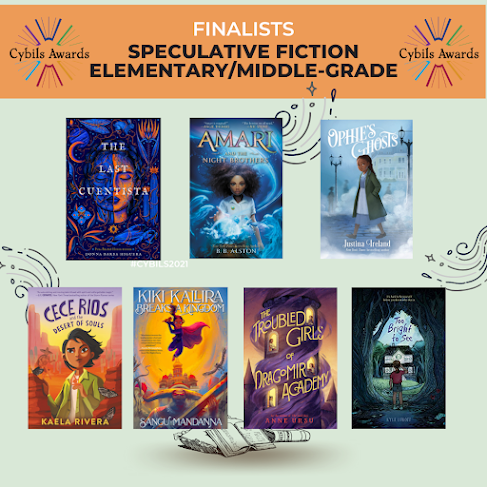
The finalists for the Cybils Awards have been announced; here's the elementary/middle grade speculative fiction list! (and of course it wasn't possible to shortlist every great books...Here's panelist Valinora Troy on some others she loved)
Three at alibrarymama--Willodeen, by Katherine Applegate, The Beatryce Prophecy. by Kate DiCamillo, and Robber Girl, by Franny Billingsley
Three at alittlebutalot - Greta and the Ghost Hunters, by Sam Copeland, Stuntboy, In the Meantime, by Jason Reynolds, and Peanut Jones and the Illustrated City, by Rob Biddulph
Instead of round-up the mg sci fi/fantasy post from this week, I get to go on a long long drive on the worst possible day of the year to do same in order to take my kid back to college.....
Welcome to this week's round-up, in which I have nothing of my own to share because I have bitten off way more than I can chew in the home renovation department.....sigh. Let me know if I missed your post!
The Reviews
Aru Shah and the City of Gold, by Roshani Chokshi, at Sifa Elizabeth ReadsDragon Mountain, by Katie & Kevin Tsang, at Valinora Troy
Dragon’s Winter by Kandi J Wyatt, at The Faerie ReviewHi all! Here's what I found of interest to us fans of mg sci fi and fantasy this week; please let me know if I missed your post!
The Reviews
The Accidental Apprentice (Wilderlore #1), by Amanda Foody, at SemicolonBeasts and Beauty by Soman Chainani, at Fantasy Cafe
Beyond the Birch, by Torina Kingsley, at Quirky Cat's Fat StacksAsh lives in an alternate ancient Egypt, where the gods walk among the mortals, and where solar tech has reached great heights (literally--cool solar powered flying ships!). But there's no reason the gods would want to come to Ash's village, out in the middle of the desert, and though there's solar tech, Ash and his guardian can't afford the cool things Ash would like. Ash's guardian has been training him fiercely all his life, in martial arts, survival, and learning, but Ash can't visualize a future beyond the backwater village that's all he's seen of the world.
On the night of his 12th birthday, that changes. His guardian explains that Ash was born on the same day s Prince Khufu, making him a candidate for the honor of serving as the princes shadow--a companion for life, tasked with protecting, and even dying, for the prince. And the next day a solar barge arrives to take Ash and his mentor to the royal capital, where the candidates will be pitted against each other. There can only be one shadow prince.
And so Ash takes part in five days of tests, each day orchestrated by a different deity. Demon slaying, battle with monsters, and impossible tasks await. It is expected that many candidates will be killed. Ash doesn't give himself great odds, but he's determined to try, and as he begins to see in Khufu someone he'd be glad to serve, his resolve stiffens.
Some of the other contenders are friendly, and form an alliance with Ash. Others are determined to win at any cost. And this group of shadow prince contenders faces an additional challenge. The god Set does not want any of them to survive, and uses his powers of chaos to interfere with the tests, making them even more horrendous, and there's tension in the royal family that also adds to the danger the kids are in.
It's tremendously gripping and readers who love dangerous contests will of course be hooked! The violence is not so great, though, that it will be off-putting to those who prefer more character-driven books; though the trials are violent they don't pit the kids directly against each other until the very last day, and there's plenty of time for Ash to develop the first real friendships of his life, and have his mind blown by the royal city and all its panoply.
So basically lots of really exciting stuff happens, some of it tense, some entertaining (I loved Prince Khufu's fierce little bouncing hippo protectors), and Ash is a good kid who's easy to cheer for. There are a lot of characters introduced, but the important ones are easy to track of. The Egyptian gods are incredibly powerful, and idiosyncratically weird, adding entertainment value and a Riordan-esque feel to the story. I loved the solar-punk alternate Egypt too--it was just straight out really cool.
Short answer-this book gave me Wings of Fire vibes, even though I can't do a point by point argument for this. Give it to your sixth graders, and they will love it!
(added kid appeal bonus--one of the contenders who are Ash's friends is a young lioness....)
disclaimer: review copy received from the publisher
At the start of seventh grade, Jason and his friend Steve are confronted with bewildering fair of clubs they could join. Amongst the panoply and promotion is one odd club, H.A.I.R. There's no description, nothing to try to make it alluring; there's just a piece of paper on which no one has signed their name. Jason and Steve seize the chance to be founding members....and when other kids see Glamorous Steve, as he's known, signing up, they do to.
So H.A.I.R. ends up with with 8 seventh graders, who are surprised to learn that the club will be in charge of monitoring the school's ritzy new security cameras (donated with the stipulation that H.A.I.R be created for this purpose). The kids are a mixed lot, but all are eager to mess with their new tech, and they are given a tiny room down in the basement, and start going through the security footage.
The footage proves more interesting then they could have guessed. They see themselves in the school cafeteria, five years in the future! None of them are happy about what they see.
And so they set themselves to figuring out what's going on, determined to change the future. In the processes there's social tension the way only 7th grade can be social tense, quite a few bits that made me chuckle, and many more that made me grin, some mayhem, and a very affectionate skunk....and the outcome is just what the instigator of the whole shebang would have wanted (or will be wanting, and will be inspired to set in motion....).
It's a quick and entertaining read, and it might inspire a few of the target audience to introspection about what they might change about themselves (one character, for instance, decides to embrace her inner nerd, another starts working on being less self-centered, etc.; the sort of things that are useful nudges for many 7th graders.). If you are looking for an oddball, funny sci-book with middle grade angst (and a skunk), this is a good pick!
(Oddball and quirky is not own personal favorite sort of sci fi, and I don't like being made to think of all the things I'd like future me to have nudged me to change, but despite that I enjoyed it quite a bit!)