xmlns:xsi="http://www.w3.org/2001/XMLSchema-instance"
xsi:schemaLocation="http://www.sitemaps.org/schemas/sitemap/0.9
http://www.sitemaps.org/schemas/sitemap/0.9/sitemap.xsd">

 A long time ago, I read a request on a teacher's blog for recommendations of science fiction stories for the younger reader (which I just tried finding again, to no avail...). I didn't have anything to add at the time that hadn't already been mentioned, but I do now--The Green Book, later reissued as Shine, by Jill Paton Walsh, illustrated with pencil drawings by Lloyd Bloom (1981/1988, 74 pp, 8 year olds and up). If Ursula Le Guin were to write a science fiction story for young readers, it might be something like this, and since I think Le Guin is brilliant, this is high praise.
 Today's Timeslip Tuesday book is the one that I consider such a Classic Example of the genre that I used it for my T.T. graphic (although with a different cover from the most recent edition at left)-- Charlotte Sometimes, by Penelope Farmer (1969, reprinted many times, a good one for ages 9-12 ish). I am not alone in thinking this- the book shows up in just about all the critical essays on timeslip stories I've read (2), and even when it first came out its quality was recognized--in a review written that year, Margery Fisher described Charlotte Sometimes as "…a haunting, convincing story which comes close to being a masterpiece of its kind." (Growing Point, November 1969, p 1408).
 A while ago I wondered if girls re-read for comfort more than boys. Now I am wondering if introverts re-read more than extroverts. The former feel most at ease in the company of old and dear friends, that later seek out the new and exciting, and want to make new friends...
 I started thinking since last December about heirs to Anne, after reading Undercover, by Beth Kephart (Harper Teen,2007). This book, which was nominated for the YA Cybils awards, is about Elisa, a very engaging "literary smart girl" who writes poetry, falls in love, gets depressed about her family situation, ice skates alone on a frozen pond at night, has a great English teacher, and keeps a notebook of words. It's a lovely book--I just re-read it more peacefully than I had a chance to last fall (what with the other 120-ish ya books to read for the Cybils*), and I highly recommend it to anyone who likes metaphors, words qua words, and books about teenage girls.
Mirasol and the new Master are drawn to each other, even though she suspects their union is prohibited, and their smoldering attraction—plus the gorgeously evoked magic and the escalating threat that Willowlands will be usurped—gives this tale its sizzle. In the best McKinley fashion, the fantasy realm is evoked in thorough and telling detail, with the energy of the narrative lending excitement to descriptions of even the most stylized rituals. A lavish and lasting treat.


 12 year old James had hoped for a pleasant summer at home in the states with his parents, a summer where music wasn't going to be front and center, the way it generally was. With his parents and his grandparents on both the black side of the family and the white all musicians, James is sick of the whole music thing, and wants to find an identity of his own.
"James was fascinated by everything, and at the same time uneasy. He wasn't sure why. He tried to think, but in that hubbub it was a while before he realized what he was seeing. At home, at least anywhere he went, he had never been in a next-to-all-white world, or even an all-white crowd, though a few Boston concert audiences had come close. Here he didn't see a face that wasn't white..." (pp 99-100).
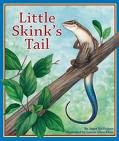 I have always been partial to skinks. Partly it's because I think "skink" is fun to say, especially if you say "skeeenk." Partly it's because there are skinks at my parents' house, so they remind me of my happy childhood (and reasonably happy young adulthood, and happy trips down there with my own kids). Little Skink's Tail, by Janet Halfmann, illustrated by Laurie Allen Klein (2007, Sylvan Dell Publishing), is the cutest skink picture book I have ever read (it is also the only skink book I've ever read, but still it's darn cute).
 It was my son's birthday on Saturday--he is now 8. Along with Queen's Greatest Hits, which he had specifically requested, and other stuff, we gave him five books, all of which were non-fiction (I guess he's not yet in on the shared secret about fiction vs non-fiction). And it was very gratifying to see him take one of his new books (Building Big, by David Macauley) to camp with him.
  So a day late, here are the pictures I took for Cloudscome's Sunday Garden Stroll. Incidentally, I hate July and August as gardening months. Sure, there are some pretty things blooming, like this crocosmia, but as always, it is too dry, I haven't mulched enough, planted enough, weeded enough, etc. I guess I just like to leave myself plenty of room for improvement, so I have something to daydream about next year.
 What we do have a lot of is zucchinis, even though there are only three plants. I would like to sell them at the library for 25 cents each, but my husband says that this would be both weird and possibly against the law. But 64 zucchinis sold, and I could buy a book. We are getting four a day, so it would only take two and a half weeks....
 A String in the Harp, by Nancy Bond (1976)
"Outside, the wind had begun in earnest. It came in hard gusts up the coast from the southwest, flinging its self at the houses on the top of Borth cliff, hurtling over miles of churning sea. Waves drove across the wide beach to the very foot of the sea wall, making the thin string of houses look terribly vulnerable.When Peter does tell Jen, at first she can't believe in the magic of the key, but gradually she and Becky are drawn in too, to help Peter return the key to its owner-a journey that will take him back in time...
Something was coming. Peter knew it, and he was pretty sure he was going to be involved in it. Against his skin the Key felt hot. There was no vibration as yet, but...Peter was afraid and yet he couldn't take it off, he couldn't get rid of it. He was drawn to the Key even as it frightened him. He wished someone else knew. Jen was the only person he could imagine telling, but he had sense enough to see she was in no mood to believe such an outrageous story. he heard the girls talking in the kitchen and felt very much alone, but he'd refused them."
"At the head of the valley they looked back, and it surprised neither of them to see the waters of Nant-y-moch stretched across the valley, filling the space they had just ridden the moterbike through."Misc. comments: A String in the Harp is Newbery Honor Book, so happily it is still easy to find. It does not seem at all dated-I imagine the weather in Wales in winter is still much the same, and the feelings of culture shock, grief, and loneliness that this family feel are also timeless.

 And as I returned to Girl, Hero, I decided that this is a book that I will try to get my boys to read when they are teenagers. It’s a book that will, perhaps, help them understand what it might feel like to be a girl stuck in a situation that stinks in many ways. A girl who would like so much to be rescued, but who, in the end, learns that taking action beats escapist day-dreaming.
  So begins Crocs, by David T. Greenberg, illustrated by Lynn Munsinger (2008, Little Brown). The hero flees the horrors of the urban jungle, to a tropical island where at last he feels at peace. But this does not last long:
 Frannie's parents are divorced, and although she lives with her mother, she spends much of her time happily with her father, helping him scrounge for found art in the trash, admiring his woodworking, and doing her own drawings. But one afternoon, she finds him lying dead on the bathroom floor. Sorting through his belongings weeks later, she finds a present--a beautiful wooden box, with her name, Frances Anne, and the number 1000, engraved on it. Inside are painted wooden puzzle pieces, and a picture of a village by the sea. Taking home this gift, she starts to secretly piece the puzzle together...and (Oh bother. I don't want to spoil it. But this is where the timeslipping happens).

"...Aigredoux, basking in the flame of dawn sunlight, resotred to its former glory.Her dreams show her the tragedies that happened at this place a hundred years ago, and she learns what her father meant by "blood money." She turns the past to her own use, writing the stories down, and sending them off to be published, so that her mother might read them, and come back to save her daughters.
It asn't until she saw Aigredoux like this, blinding and beautiful and powerful, that Tennyson truly understood what it meant to be a Fontaine."
 The Gates of Bannerdale, by Geoffrey Trease. The last in the very engaging Bannerdale series (published 1949-1956), about four children growing up in the Lake District, takes Bill and Penny to Oxford University. This series was recently reprinted by Girls Gone By Publishers.
 Winter Holiday, by Arthur Ransom. A frozen lake in the north of England gives a group of children the chance to live the life of arctic explorers, culminating in a race to the "north pole" through a raging storm. This is my favorite of the Swallows and Amazons books.
 My favorite of the Moomin books (Tove Jansson) is also the coldest-Moominland Midwinter. If you read one winter book this summer, it should be this one. A troll child wakes from hibernation to find his summertime world transformed. The creature to the right is the Groke, a being so cold that it freezes whatever it sits on...
 So in this hopeful, looking forward to school frame of mind, today's book review is a first day of school story: Splat the Cat, written and illustrated by Rob Scotton (HarperCollins, 2008). Never before has an artist so vividly captured the anguished nervousness, verging on hysteria, of a kitten who doesn't want to go to school.
 The first timeslip book that I can remember reading was The Gauntlet, by Ronald Welch (1951). I was 9-ish, and well on my way to a love affair with all things medieval, and I thought this book was just the greatest thing ever.
"Hardly realizing what he was doing, he slipped his right hand inside the heavy gauntlet, and his fingers groped inside the wide spaces, for it was far too large for his small hand.Still in the present, Peter learns that he is related to the De Blois family, the Norman lords of the nearby ruined castle. In the local church, he finds the brass plaque commemorating a boy named Peter De Blois, who died 800 years ago.
From behind there came the thud of hooves, a shout, shrill and defiant, the clang of metal on metal, and then a confused roar of sounds, shouts, more hoof-beats, clang after clang, dying away into the distance as suddenly as they had come. The gauntlet slipped form Peter's hand, and he shook himself as it he had just awakened."
 The first was Alligator at Saw Grass Road, illustrated by Lori Anzalone (2006, Smithsonian's Backyard). And, as was the case of the hermit crab book mentioned above, this was the best picture book about alligators that I have read (I have read at least three others. Probably more. It is a testimony to their mediocrity that I can't remember what they were). My 7 year old, dismissive at first, was soon engrossed in the story of an female alligator and her children (whom we meet first in the egg). My 5 year old, less jaded, was enthusiastic from the start.
 The second was Polar Bear Horizon, illustrated by Adrian Chesterman (2006, Smithsonian Oceanic Collection), telling the story of a mother polar bear and her young cubs. Since I haven't, to the best of my knowledge and belief, read any other non-fiction books about polar bears, I can't make any sweeping statements about this one. But we enjoyed it (except that it looks like the illustrator drew goofy smiles on all the bears, which got on my nerves a bit. But maybe polar bears just naturally come with goofy smiles?).
  We do not have a particularly communal approach to gardening--each of us has our own special bits, and special plants. These two are definitely my husband's plants--he picked them and planted them, and built their trellis.
 Button styles

